Your water bill lands on the mat and says £54 for the quarter. You glance at it, decide it seems about right, and move on to the next envelope. What that bill never mentions is what happened an hour earlier, when you filled the kettle, ran a load of washing, and stood under the shower for ten minutes before work. Every one of those litres had to be heated first, and that cost is nowhere on the paper you just opened. It is sitting quietly inside your gas or electricity bill instead, where almost nobody ever traces it back to water.
Most UK households have a rough idea what they pay their water company each year. Almost none know what they pay to heat that water on top, because the two charges arrive on completely different bills and never get added together in anyone’s head. This calculator puts both numbers side by side for the first time, so you can see the real annual cost of every shower, bath, tap, and appliance in your home, not just the half that shows up on your water statement.
Who Is This Calculator For?
This tool works for any UK household that wants to understand its full water and heating costs. It is particularly useful if you are:
- Someone who has never seen a metered water bill and has no idea whether a meter would save them money. The calculator separates usage-based charges from fixed standing charges, which is the key comparison anyone thinking about switching to a meter needs to see
- Anyone who suspects their household uses more water than it should but has no clear picture of which habits, appliances, or fixtures are driving the cost
- A homeowner who has noticed a possible leak (a dripping tap, a running toilet, or a damp patch somewhere) and wants to understand how much it could be costing before calling a plumber
- Someone trying to reduce household bills who has already looked at energy and groceries but has not yet addressed water use
- Anyone who has recently moved home and wants to understand what a normal water bill looks like for their household size and habits
- Renters who pay their own water bills and want to see whether the habits of the household are keeping costs reasonable or running them higher than they need to be
Who Is This Calculator Not Suitable For?
- Homes in Scotland. Scottish Water operates differently from English and Welsh water companies and the billing structure does not follow the same metered versus rateable value model. The calculator is built around England and Wales pricing.
- Anyone on a business water account. Commercial water tariffs are structured differently and the standing charges and unit rates do not map cleanly to residential billing. If you are running a business from home and want to know the cost of that usage, speak to your water company directly about your tariff.
- Anyone looking for a precise bill audit. The calculator works from your estimates of shower length, appliance use, and habits. It produces a realistic annual figure rather than a forensic account of every litre. For exact figures, your water meter reading alongside your bill is more accurate.
How to Use the Calculator
Start with the profile section. Enter your water company’s cost per cubic metre. You can find this on your latest bill or your water company’s website. Enter the annual standing charge, the energy rate you pay to heat water (gas is typically around 7 pence per kWh; an electric shower or immersion heater runs closer to 24 pence), and how many people live in your household.
Use the budget slider to set what you intend to spend on water each year, and the behaviour slider to honestly rate how wasteful your household habits are.
Toggle whether you are on a water meter or still paying rateable value. The calculator notes that this affects whether saving water directly reduces your bill.
Work through the showers and baths section, add any leaks you know about, toggle on the appliances your household uses, and answer the five behavioural questions. The results update as you go.
Enter your household water habits: showers, baths, leaks, appliances, and garden use. The calculator works out your annual water cost, the energy cost of heating that water, and shows where the biggest savings are.
Your Water Profile
Start here. These fields set your unit costs (water and energy), household size, an optional yearly budget, and a rough honesty check on how careful your household is with water. Everything below is calculated using these values, so if your rates are wrong the totals will be too: you can find them on your most recent water and energy bills.
Are you on a water meter?
On a meter: your bill scales with usage. The calculator shows what reducing consumption would save you directly.
🚿 Showers and Baths
These are typically the biggest water costs in any household. A 10-minute power shower uses around 150 litres: more than a full bath.
💧 Leaks
A dripping tap at 1 drop per second wastes around 11,000 litres per year. A leaking toilet can waste 200 to 400 litres every single day without you ever noticing.
🏠 Appliances and Fixtures
Toggle on each appliance you use. Older washing machines use up to 120 litres per cycle while modern A-rated models use around 45 litres.
Habits and Behaviours
These feed into your behavioural waste estimate. Be honest: the results are only useful if the inputs are accurate.
£0
Total annual water charge based on your usage and current tariff, including standing charge£0
Cost of heating shower and bath water using your energy rate: typically 2 to 3 times the water cost itself0
Total household water use across all habits. UK average household uses around 330 litres per day£0
Estimated saving if leaks are fixed and behavioural waste is halved: includes water and energy£0
per year for your household0
litres per day£0
£0
£0
Includes both water cost and hot water energy cost where applicable.
Share it with friends or family who might find it helpful.
The Hidden Half of Your Water Bill: Energy to Heat It
This is the number that surprises almost everyone, and it is the angle no other UK water calculator has ever made clearly visible.
Heating water requires energy. Specifically, heating one litre of water by 40 degrees Celsius, roughly what is needed to take cold water from the mains and turn it into a comfortable shower, requires around 0.047 kilowatt hours of energy. At 24 pence per kWh for an electric shower, that is about 1.1 pence per litre heated. At 7 pence per kWh for gas through a combi boiler, it is around 0.3 pence per litre.
Those numbers sound small. Applied to a household that uses a power shower for eight minutes per day at 15 litres per minute, the daily heated water volume is 120 litres. At electric shower rates, the energy cost of heating that water is £1.32 per day. Across a year that is £482, before a single penny of water company charges.
Research from the Energy Saving Trust found that the average UK household spends more on heating water than on space heating during warmer months. Showers, baths, hot taps, and dishwashers collectively account for around 25 to 30 percent of a typical household’s annual energy bill. When people wonder why their energy costs are high, the water heating component is almost never the first thing they look at, even though it is one of the easiest to bring down.
The calculator shows both costs in a single combined figure: what your water company charges plus what your boiler or shower heater spends keeping that water hot. For most households the combined number is somewhere between £600 and £1,400 per year depending on shower habits, household size, and appliance use. For households with power showers and large families it can go much higher.
Water Meters in England and Wales: Are You Better Off With One?
Around 55 percent of homes in England and Wales are still charged for water based on rateable value, a fixed annual charge based on the rental value of the property as assessed in 1990. This means they pay the same bill regardless of how much water they actually use.
The other 45 percent have meters and pay based on actual consumption at their water company’s published unit rate, plus a standing charge.
The question of whether a meter saves you money depends almost entirely on how much water your household uses relative to the typical usage for your property type. Research from the Consumer Council for Water found that metered customers save an average of around £100 per year compared to what they would have paid on a rateable value basis, but this average hides a wide range of outcomes. A single person in a large house is very likely to save money on a meter. A family of five in a small house with multiple daily showers and a garden to water might pay more.
Most water companies in England and Wales will install a meter for free and allow customers to trial it for at least 12 months, returning to rateable value billing if they end up worse off. Some companies also offer a free assessment of whether a meter is likely to benefit your household before installation.
Water companies with the highest tariffs (South West Water charges around £2.50 per cubic metre) make metering matter more in both directions. Affinity Water, at around £1.10 per cubic metre, gives metered customers a smaller financial incentive to reduce consumption.
How Much Does a Dripping Tap Really Cost?
The dripping tap is the most cited water waste example in UK personal finance writing, and for good reason. The numbers are genuinely striking once you work them out properly rather than leaving them as a vague “adds up over time” statement.
A tap dripping at 60 drops per minute, which is a very common rate for a worn washer, loses around 3.4 litres per hour, or approximately 82 litres per day. Over a full year that is around 30,000 litres of wasted water, which at a typical UK metered rate of £2 per cubic metre costs around £60 per year from a single dripping tap.
Research from Waterwise found that a dripping tap dripping at just one drop per second wastes 11,000 litres per year. Two dripping taps double that. A running toilet cistern, which is often silent and therefore goes undetected for months, can waste 200 to 400 litres per day, over 100,000 litres per year, and cost £200 or more annually at metered rates.
The fix in most cases costs under £5. A standard tap washer replacement requires a screwdriver, a spanner, and around 15 minutes. A toilet float valve that causes a running cistern typically costs £10 to £20 as a replacement part and is straightforward to replace without a plumber.
The catch is that most people do not check for leaks systematically. The calculator’s leak section quantifies what you already know about so the annual cost is visible, which is a more useful prompt than “you should check for leaks” in the abstract.
Showers vs Baths: What the Numbers Actually Show
The conventional wisdom is that showers use less water than baths. This is true in some cases and false in others, and the gap between the two scenarios is large enough that it is worth understanding which situation your household is actually in.
A standard bath uses around 80 litres when filled to half capacity and around 150 litres when full. A lukewarm shallow bath uses much less. Most people in practice fill their bath to somewhere between 80 and 120 litres.
A power shower at 15 litres per minute running for 10 minutes uses 150 litres, the same as a full bath. A standard shower at 9 litres per minute for 8 minutes uses 72 litres, which is comfortably below a half-full bath. An eco-showerhead at 6 litres per minute for 8 minutes uses 48 litres.
The practical answer is that an electric power shower running for more than about 8 minutes uses more water than a typical bath, and far more energy, because it heats the water electrically at the point of use rather than using stored hot water. A short shower from a low-flow showerhead is the most water-efficient bathing option by a clear margin.
Research from the Energy Saving Trust found that replacing a bath with a shower for one person four times a week saves around 40 litres per session, around 8,000 litres and approximately £14 per year in water charges. The energy saving on top of that, from not heating a bathful of water each time, adds a good deal more.
How Much Water Does Each Appliance Use?
Understanding the water consumption of individual appliances is the first step to knowing where household use can be reduced meaningfully.
Washing machines vary dramatically by age and efficiency rating. Older machines manufactured before 2010 typically use 80 to 120 litres per cycle. Modern A-rated machines from 2020 onwards typically use 40 to 50 litres per cycle. For a household doing four loads per week, the difference between an old machine and a modern one is around 8,000 litres per year, roughly £16 in water costs and a meaningful energy saving on top.
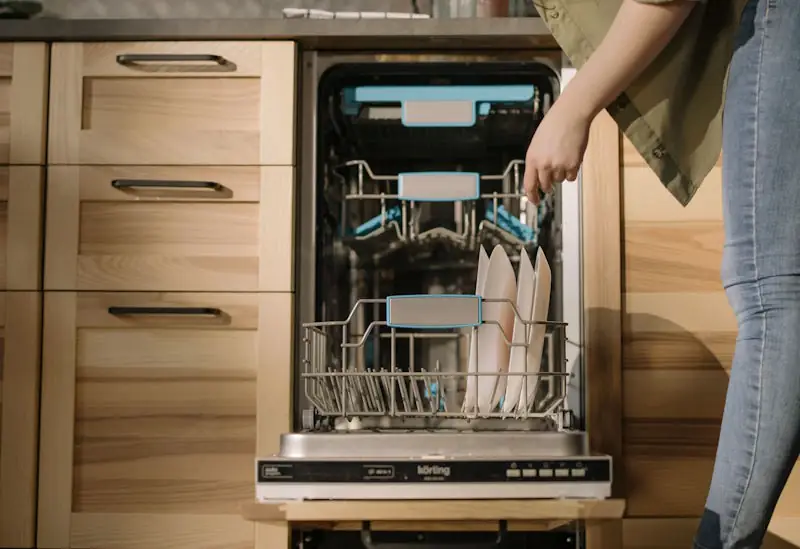
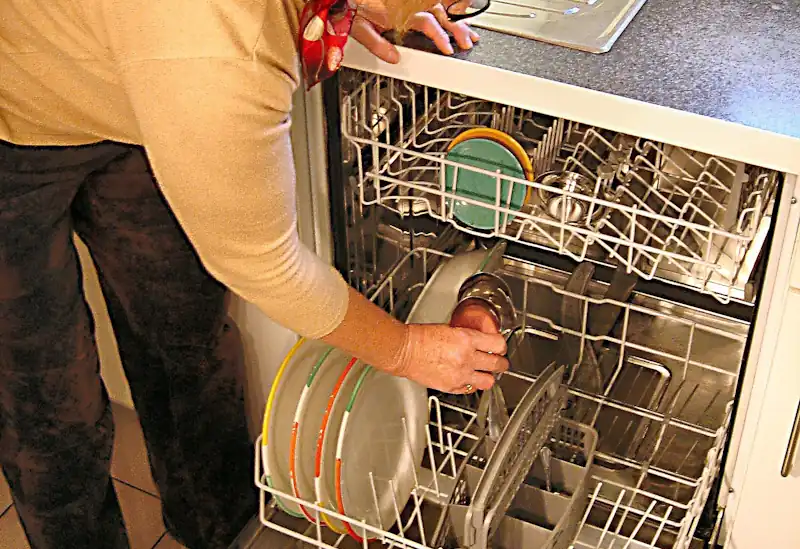
Dishwashers are often assumed to use more water than hand washing, but modern dishwashers typically use only 10 to 12 litres per cycle. Hand washing the same load under a running tap uses 40 to 80 litres depending on how long the tap is left running. The dishwasher is almost always more water-efficient when run on a full load.
Toilets are the single largest water user in most homes outside of showering. Older single-flush toilets use 9 to 13 litres per flush. Dual-flush toilets use 4 to 6 litres on the smaller flush and 6 to 9 on the larger one. For a household flushing ten times per day, switching from an old toilet to a dual-flush model saves around 25,000 litres per year, around £50 at typical metered rates.
Garden hoses use around 12 to 17 litres per minute. Running a hose for 30 minutes uses more water than a typical household uses in an entire day for all other purposes combined. A water butt collecting rainwater from a standard roof can collect enough to meet most garden watering needs through a typical English summer without using mains water at all.
The Running Tap: A Surprisingly Large Daily Loss
Leaving a tap running while brushing teeth, washing up, or waiting for hot water to arrive is one of the most common household water habits and one of the easiest to address.
A running tap flows at around 6 litres per minute. Leaving it running for two minutes while brushing teeth twice a day loses 24 litres. For a family of four doing this every day, the annual loss is around 35,000 litres, over £70 at metered rates.
Research from Waterwise found that turning off the tap while brushing teeth is the water saving behaviour most often cited by UK adults as something they intend to do but do not always follow through on. The gap between intention and behaviour here is real, and the financial case for closing it is clear once the annual total is visible rather than implied.
The calculator accounts for this through the tap-running habit question, adding a realistic daily estimate based on your answer and showing what it contributes to the annual total.
Practical Changes That Actually Make a Difference
- Shorten your shower by two minutes. For a household of two adults showering daily, cutting from ten minutes to eight minutes at a standard 9-litre-per-minute flow rate saves around 10,000 litres per year. The energy saving from heating less water is worth another £30 to £50 on top of the water saving, depending on your boiler type.
- Fix leaks promptly. A worn washer causing a dripping tap is one of the cheapest repairs in any home. A new washer costs pence and the replacement takes under 20 minutes. A running toilet cistern is slightly more involved but a float valve replacement is still a straightforward DIY job. Both are worth addressing immediately rather than leaving for months.
- Switch to a water-efficient showerhead. A good eco-showerhead reduces flow from 15 litres per minute to 6 to 9 litres without a noticeable difference in shower quality for most people. At a typical purchase cost of £15 to £30 it pays for itself within a couple of months of regular use.
- Run full loads in the washing machine and dishwasher. Running half a load uses the same water and energy as a full one. Waiting until there is a full load to run is the simplest and most consistently effective way to reduce both water and energy consumption from these appliances.
- Get a water butt for the garden. A standard water butt collecting from a downpipe costs £20 to £40 and can collect several hundred litres in a single decent rainfall. For anyone who waters a garden regularly through spring and summer, this single purchase can eliminate most of the garden hose water cost.
- Contact your water company about a meter trial. If you live alone or your household is smaller than average for your property size, requesting a free meter trial costs nothing and comes with a guaranteed return to rateable value billing if you end up worse off.
- Check Savzz for deals on home and garden products before buying any of the above. Our home accessories deals, kitchen appliance vouchers, and garden offers regularly cover the kinds of products that help reduce household bills without any change to comfort or convenience.
Frequently Asked Questions
How much does the average UK household spend on water per year?
Research from Ofwat found that the average annual water bill in England and Wales was around £448 in 2024 for a metered household, plus standing charges. This figure covers water supply and sewerage charges. It does not include the energy cost of heating that water, which adds a further £200 to £600 depending on household size, shower habits, and energy tariff. Use the calculator for a figure based on your specific usage.
How do I calculate my water cost per litre?
Take your water company’s unit rate in pounds per cubic metre (found on your bill) and divide by 1,000. At £2 per cubic metre, each litre costs 0.2 pence. The calculator does this automatically based on the rate you enter and shows both litres used and the cost alongside the energy cost of heating that water.
Is a water meter worth getting?
For most single-occupant homes and smaller households in medium to large properties, a water meter reduces bills. For large families in smaller properties who use a lot of water, the saving is less certain. Most water companies in England and Wales offer a free trial period with a guaranteed return to rateable value if you end up worse off. Contacting your water company to discuss your specific situation costs nothing.
How much water does a 10-minute shower use?
It depends on the type of shower. A power shower at 15 litres per minute uses 150 litres in 10 minutes, the same as a full bath. A standard mixer shower at 9 litres per minute uses 90 litres. An eco-showerhead at 6 litres per minute uses 60 litres. The energy cost of heating that water depends on whether you have a gas boiler, an electric shower, or an immersion heater, and the calculator accounts for all three.
How much does a dripping tap cost per year?
A tap dripping at 60 drops per minute loses around 30,000 litres per year, approximately £60 at typical metered rates. A running toilet cistern leaking 200 litres per day costs around £150 per year. Both can be fixed for under £20 in parts.
What is the difference between water supply and sewerage charges on my bill?
Water supply is what you pay to receive clean water. Sewerage is what you pay to have used water and waste removed. Both appear on a typical UK water bill and are charged at separate rates. In most metered billing structures, the sewerage charge is calculated as a percentage of your water usage on the assumption that most water you use eventually returns to the sewer. The calculator uses your water rate input for the supply charge; if you want to include sewerage costs in the calculation, enter the combined rate from your bill.
Who built this calculator?
The Savzz Water Bill Cost Calculator was built by the team at Savzz.co.uk, a UK discount code and money-saving site. We build free, practical tools designed to give honest, data-driven answers to questions about time and cost. We built it because the combination of water charges and heating costs is something no other free UK calculator addresses in one place. The hot water energy section, the water meter comparison, the leak drip visualiser, and the full appliance breakdown are all features not available in any other free tool. It is completely free to use with no sign-up required.
Home & Garden Calculators
Calculate household costs, energy usage, renovation expenses and home-related savings opportunities.
- Home Heating Cost Calculator
- Heated Blanket vs Heating Calculator
- Dishwasher vs Hand Washing Calculator
- Dishwasher Time Savings Calculator
- Air Fryer Time Savings Calculator
- Meal Prep Time Savings Calculator
- Robot Vacuum ROI Calculator
- Plastic Waste Cost Calculator
- Pet True Cost Calculator
- Cleaner vs DIY Cleaning Calculator
- Smart Home Savings Calculator
- Solar Product Savings Calculator
- UK Energy Appliance Running Cost Calculator
- Car Ownership True Cost Calculator
Final Thoughts
Most households have a clear idea of what they pay for water, but very few have a clear idea of what they pay to heat it. Once both numbers sit side by side, the real annual cost becomes far easier to understand and far easier to improve. Small daily habits, unnoticed leaks, and long showers often add more to the bill than people expect, while simple fixes and small adjustments reduce both water use and energy use at the same time.
This calculator brings the full picture together. It shows your supply charges, your heating costs, the impact of appliances, and the effect of household behaviour in one combined total. Seeing where the litres go and where the money goes makes it much easier to decide what to change, what to fix, and what is already working well.
If your combined figure looks higher than you thought, that is normal. Most people only ever see one half of the cost. The useful part is what you do next. A few practical changes can lower your bill without reducing comfort, and understanding your own usage is the first step toward making those changes confidently.